Showing posts with label New Learning. Show all posts

Wednesday, 2 December 2015

Day 62: Taking Risks

Recently, Kit Luce and I had the opportunity to spend time with intermediate teachers at Worsley Elementary School in Wasaga Beach.  A number of important ideas came out of our learning with the teachers and students.  One particular overarching theme that existed throughout the week centred around “Taking Risks”.  
Going into schools classrooms and planning lessons for students we do not know can seem risky.  We could only make educated guesses about whether we would be meeting their needs.  There may be a perception that we have the answers...when, in reality, we are coming in with questions and just as eager to learn with the classroom teachers and with the students.
The teachers take risks also.  They invite us into their rooms and we are grateful for that.  We get to see varied classroom setups, amazing approaches to teaching and it gives us the opportunity to learn from and WITH the teachers.
Lastly, we saw risk taking by the grade 7 and 8 students in how they responded to having us in their learning space. The students were incredibly kind and gracious with us.  We know very little about them and they gave us their time and attention and shared their thinking with us.  We recognized that they extended the trust they have in their teachers to us. We appreciate that and do not take it lightly.
Another conclusion we came to was the importance of Consolidation in math lessons. Our focus was to show how we could meet the needs of diverse learners in the classroom through the use of manipulatives and open and parallel tasks. Varied representations of algebraic expressions provided for multiple entry points for student understanding.
The task:
Roll a number cube twice to fill in the blanks in this pattern rule:  Start at ____, increase by ____
(no snake eyes)
  • represent this pattern using manipulatives, creating the first 4 terms
  • on your white board,  represent this pattern visually, using a table of values, numerically, graphically?
What would be 10th term?
Challenge? What would be the 100th term?
                   How can you determine an algebraic expression for your pattern?
When we looked at the patterns created we focused on the connections between the visual representations and the table of values in order to develop the algebraic expression.

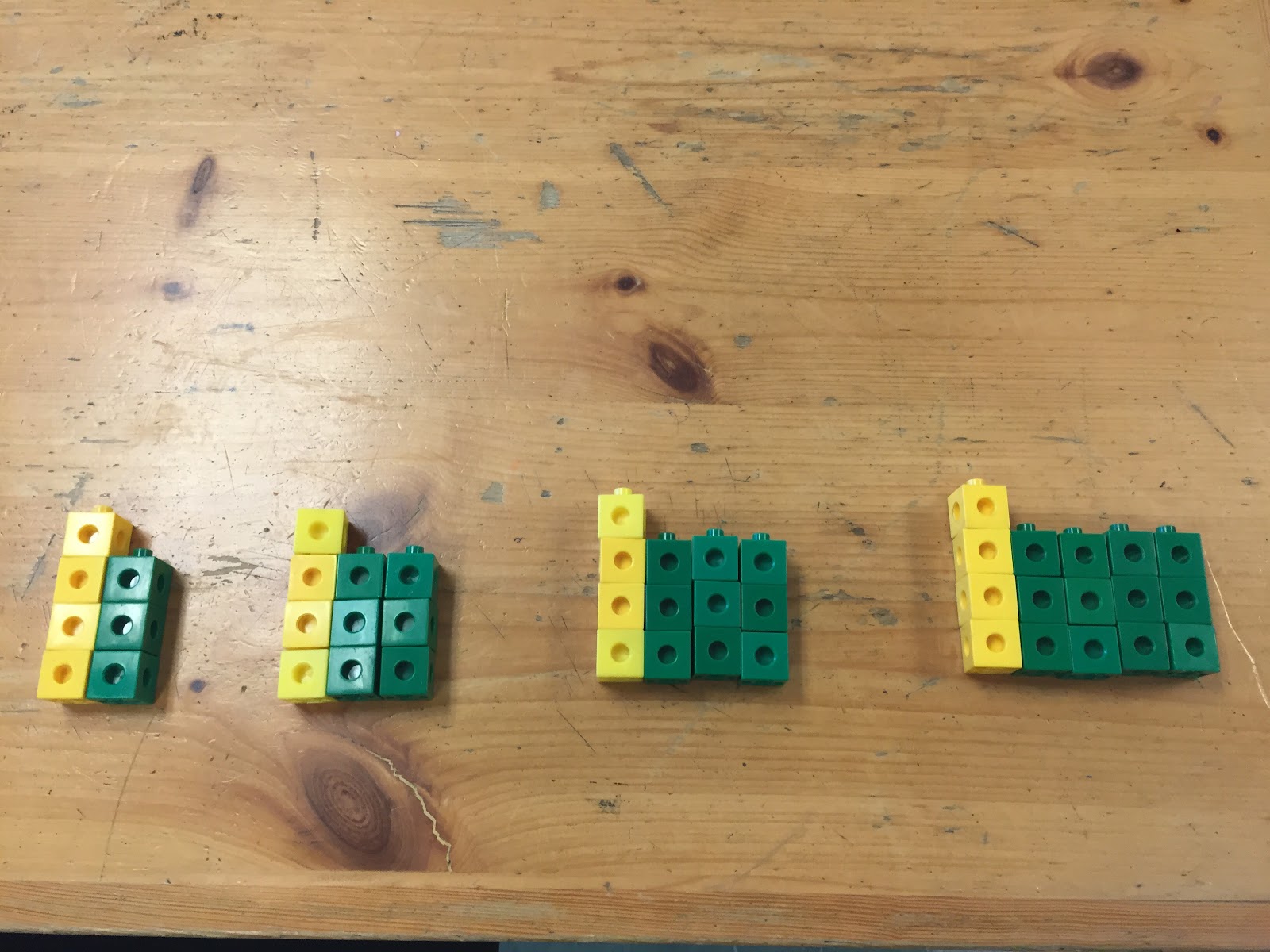
IMG_0628.JPG   IMG_5458.JPGIMG_0034.JPG
What we recognized was that consolidating conceptual understanding is essential everyday, even if the concept is revisited the next day.  The consolidation phase is where we remove the context from the activity.  This deconstruction provides students with the understanding and, hopefully, the confidence to practice and grasp the learning goal.
Thank you to Mrs. Campbell, Mrs. Hamilton, Mr. Ferris, Mr. Pike, Mr. McLean and Mr. Kemp at Worsley Elementary School for your professionalism, enthusiasm and guidance.

Monday, 26 October 2015

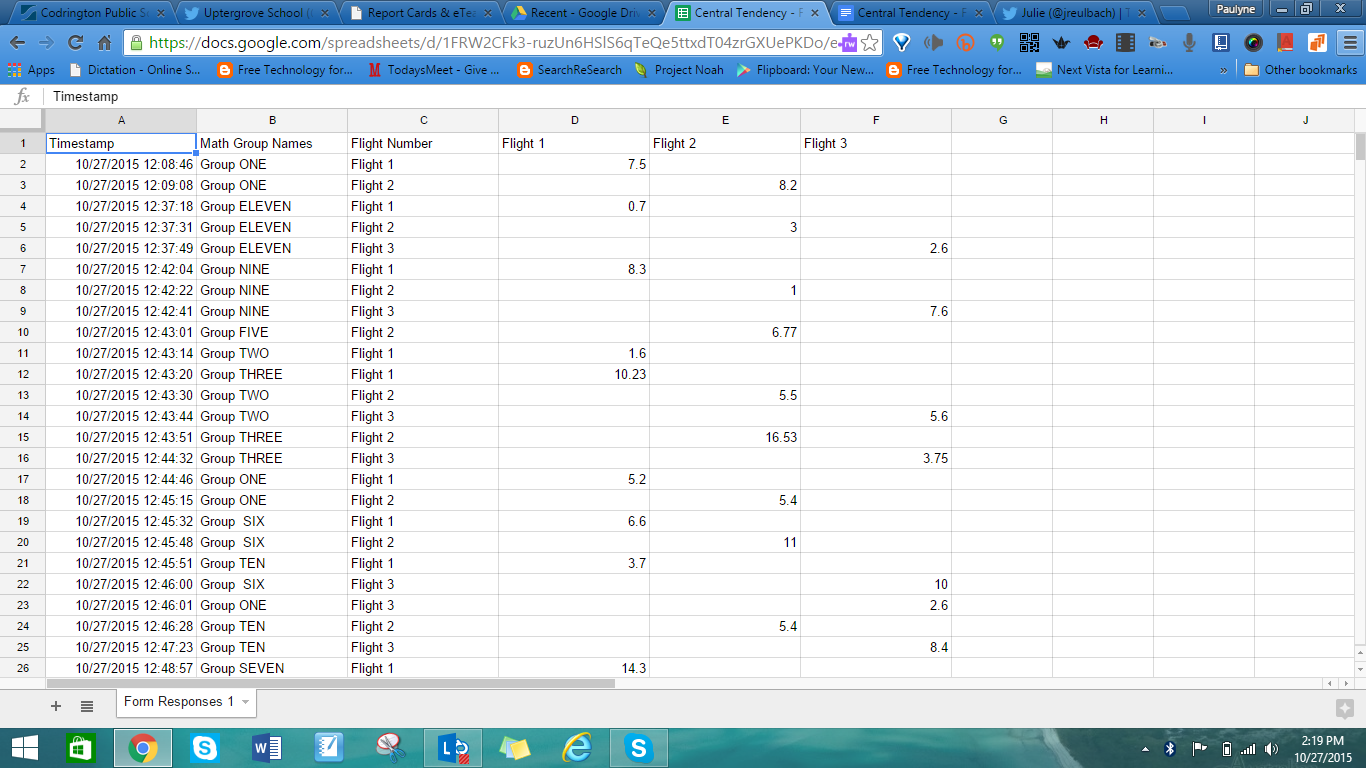
Day 35: Learning About Central Tendency - Just a short flight away…

I have had a number of opportunities to spend time with some amazing grade 7 & 8 students in Mr. Clark's class at Uptergrove PS.  Today, the students were engaged in a Math lesson where, through investigation, they were asked to demonstrate how to apply an appropriate measure of central tendency needed to compare sets of student-created data.  After some discussion/paired activities in the minds-on and action portions of the lesson, the question was posed:
How might you use central tendency in YOUR world?
The plan:
  1. make a paper airplane with a small group (2-3 in a group)
  2. we’ll go outside and fly our planes (3 flights each)
  3. measure the distance of the flights
  4. record our distances
  5. input our data into the google form!
  6. compare and analyze data
  7. determine the best measure of central tendency in analyzing the data, apply it and explain why


Of course the students rose to the challenge…


What was the result?  Highly engaged students who co-created relevant sets of data to be measured in a meaningful learning environment.  


So, why hands-on math learning?
*Learning through concrete representations is engaging.
*Students get the opportunity to move about and get physically involved in the math they are learning.
*Manipulating physical objects can work as tools to help conceptualize understanding.


What an exceptional afternoon in a terrific, intermediate class!!  Thank you, Mr. Clark for the opportunity to co-plan and co-teach!!


NOTE: **This paper airplane idea was found at ispeakmath.org by Julie Reulbach.
 

Friday, 16 October 2015

Day 29: Blue Jays Fever is Alive and Well in Grade 5

We have all been swept up in the excitement of our Jays' success!!  Game 5 of the series between the Toronto Blue Jays and the Texas Rangers sent many of us to the edge of our seats.  As fans, we were rewarded with a victory and we are now onto the next round! 
Today, I had the privilege of visiting a grade 5 classroom where the student inquiry of the day focused on baseball success.  The over-arching inquiry question presented to the students was "How does a team make it to the World Series?"

Student groups were lead through a series of questions, group inquiries, and research opportunities to find evidence as to how a MLB team could win the World Series.  They learned how the rules varied between American and National leagues, the various divisions within a league, the post-season match-ups, strategies, etc.  
What Dave Billark (grade 5 teacher at Orchard Park PS) discovered is that the more the students inquired, the more questions they had!  Students were motivated to engage in a current, real-life approach to learning.  He recognized that when the students were invested in the learning and genuinely cared about the questions they asked, they would persevere in finding the answers to their questions.  

The real teaching moments came from the student research. Guiding students in how to critically determine and analyze what they were reading and interpreting was the big challenge!  The reward?  Student-led inquiry that was meaningful for them! The grade 5's gained insight, research skills and relevant information about a current event.

I suspect even "Joey Bats" would be impressed!!

Thank you, Dave Billark at Orchard Park PS for the invitation into your class to see your students' amazing work!

Thursday, 17 September 2015

Day 9: Fresh Ideas

Have you checked out the new tabs above? Who doesn't love new stuff, right?! 
So,why is the best stuff always so hard to find? Our best new learning should be visible . With that in mind, we are looking for places to store our freshest new learning, outside of the SCDSB Staff > Teaching pages. Teachers Pay Teachers?...forget about it! The BEST stuff is usually FREE. Fresh ideas and resources are meant to be shared, so lets get started. Right here. Right now.
We welcome your ideas about Fresh Stuff and the Virtual Music Room. Are the supports useful? What else would you want to see there? What ideas do you have about getting the word out? Come on. Do your part...because your great ideas were made to be shared.

Jamila Monahan