Recently, Kit Luce and I had the opportunity to spend time with intermediate teachers at Worsley Elementary School in Wasaga Beach. A number of important ideas came out of our learning with the teachers and students. One particular overarching theme that existed throughout the week centred around “Taking Risks”.
Going into schools classrooms and planning lessons for students we do not know can seem risky. We could only make educated guesses about whether we would be meeting their needs. There may be a perception that we have the answers...when, in reality, we are coming in with questions and just as eager to learn with the classroom teachers and with the students.
The teachers take risks also. They invite us into their rooms and we are grateful for that. We get to see varied classroom setups, amazing approaches to teaching and it gives us the opportunity to learn from and WITH the teachers.
Lastly, we saw risk taking by the grade 7 and 8 students in how they responded to having us in their learning space. The students were incredibly kind and gracious with us. We know very little about them and they gave us their time and attention and shared their thinking with us. We recognized that they extended the trust they have in their teachers to us. We appreciate that and do not take it lightly.
Another conclusion we came to was the importance of Consolidation in math lessons. Our focus was to show how we could meet the needs of diverse learners in the classroom through the use of manipulatives and open and parallel tasks. Varied representations of algebraic expressions provided for multiple entry points for student understanding.
The task:
Roll a number cube twice to fill in the blanks in this pattern rule: Start at ____, increase by ____
(no snake eyes)
- represent this pattern using manipulatives, creating the first 4 terms
- on your white board, represent this pattern visually, using a table of values, numerically, graphically?
What would be 10th term?
Challenge? What would be the 100th term?
How can you determine an algebraic expression for your pattern?
When we looked at the patterns created we focused on the connections between the visual representations and the table of values in order to develop the algebraic expression.

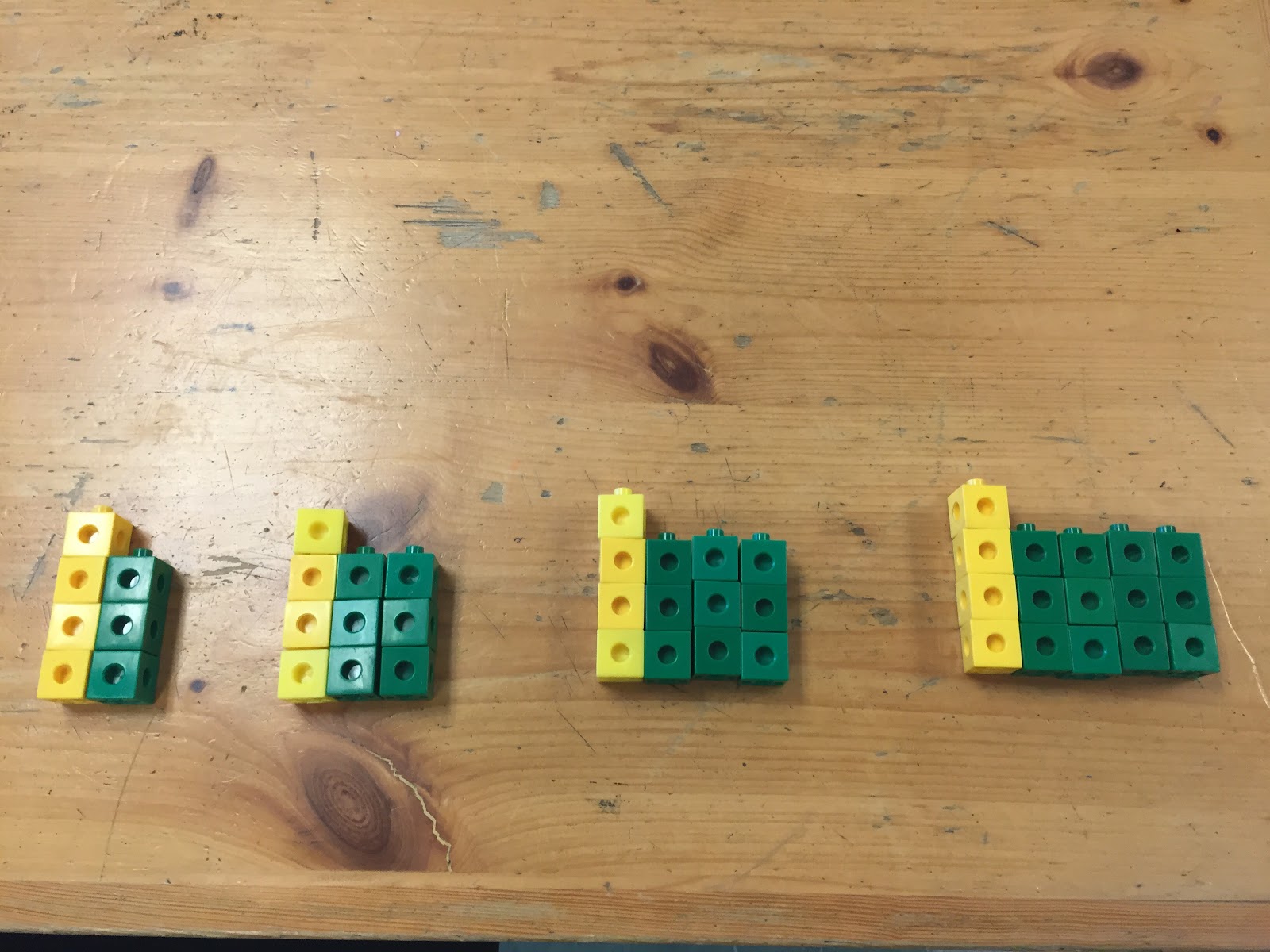

What we recognized was that consolidating conceptual understanding is essential everyday, even if the concept is revisited the next day. The consolidation phase is where we remove the context from the activity. This deconstruction provides students with the understanding and, hopefully, the confidence to practice and grasp the learning goal.
Thank you to Mrs. Campbell, Mrs. Hamilton, Mr. Ferris, Mr. Pike, Mr. McLean and Mr. Kemp at Worsley Elementary School for your professionalism, enthusiasm and guidance.


