Showing posts with label math. Show all posts

Wednesday, 2 December 2015

Day 62: Taking Risks

Recently, Kit Luce and I had the opportunity to spend time with intermediate teachers at Worsley Elementary School in Wasaga Beach.  A number of important ideas came out of our learning with the teachers and students.  One particular overarching theme that existed throughout the week centred around “Taking Risks”.  
Going into schools classrooms and planning lessons for students we do not know can seem risky.  We could only make educated guesses about whether we would be meeting their needs.  There may be a perception that we have the answers...when, in reality, we are coming in with questions and just as eager to learn with the classroom teachers and with the students.
The teachers take risks also.  They invite us into their rooms and we are grateful for that.  We get to see varied classroom setups, amazing approaches to teaching and it gives us the opportunity to learn from and WITH the teachers.
Lastly, we saw risk taking by the grade 7 and 8 students in how they responded to having us in their learning space. The students were incredibly kind and gracious with us.  We know very little about them and they gave us their time and attention and shared their thinking with us.  We recognized that they extended the trust they have in their teachers to us. We appreciate that and do not take it lightly.
Another conclusion we came to was the importance of Consolidation in math lessons. Our focus was to show how we could meet the needs of diverse learners in the classroom through the use of manipulatives and open and parallel tasks. Varied representations of algebraic expressions provided for multiple entry points for student understanding.
The task:
Roll a number cube twice to fill in the blanks in this pattern rule:  Start at ____, increase by ____
(no snake eyes)
  • represent this pattern using manipulatives, creating the first 4 terms
  • on your white board,  represent this pattern visually, using a table of values, numerically, graphically?
What would be 10th term?
Challenge? What would be the 100th term?
                   How can you determine an algebraic expression for your pattern?
When we looked at the patterns created we focused on the connections between the visual representations and the table of values in order to develop the algebraic expression.

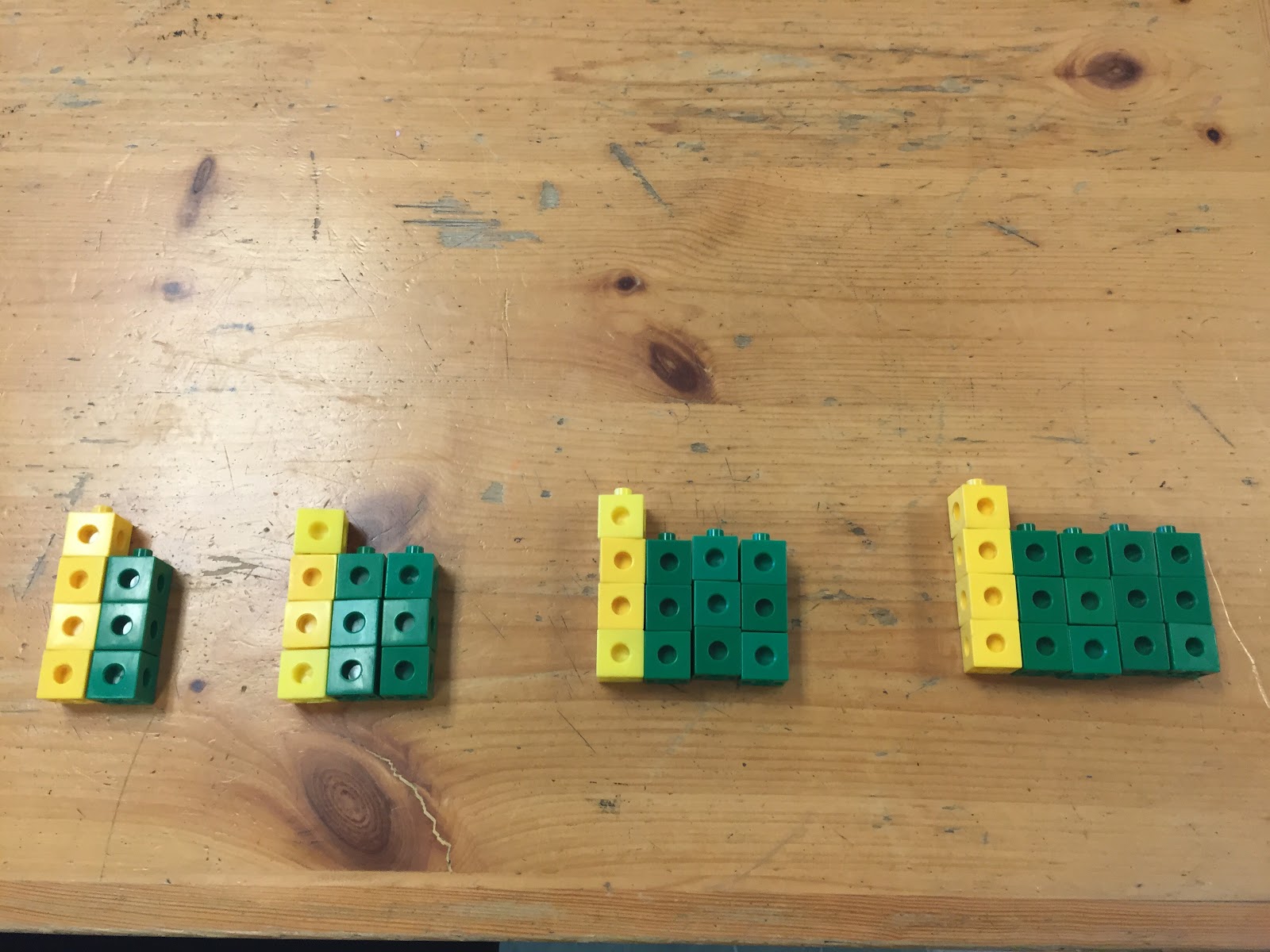
IMG_0628.JPG   IMG_5458.JPGIMG_0034.JPG
What we recognized was that consolidating conceptual understanding is essential everyday, even if the concept is revisited the next day.  The consolidation phase is where we remove the context from the activity.  This deconstruction provides students with the understanding and, hopefully, the confidence to practice and grasp the learning goal.
Thank you to Mrs. Campbell, Mrs. Hamilton, Mr. Ferris, Mr. Pike, Mr. McLean and Mr. Kemp at Worsley Elementary School for your professionalism, enthusiasm and guidance.

Tuesday, 24 November 2015

Day 56: Getting Creative in Math

Mrs. Boate is the Innovation Resource Teacher for Numeracy K-8 with the SCDSB.

I invited her to join our class so she might demonstrate a creative and inquisitive approach to math concepts.

Math is typically an area that is seen as procedural, methodical and 'by the book'.

When most people think of math class in school, they think of following a set of pre-ordained steps, finding out the answer, and practicing questions over and over.

And yet...that does not have to be the case!

Our topic today was an introduction to graphing and data management.

To get our 'minds on' this new topic, and to access previous knowledge, Mrs. Boate posted a bar graph that had just bars and asked: what could this be about? Student brainstormed ideas, recalling previous graphs and survey subjects.

Then she asked: what is missing? Students remembered that graphs needs labels and scales and titles.

We then checked out this awesome site: Graphing Stories 


We looked at the Costa Rica swing video--but not past the point where we saw the swing portrayed as a graph because we wanted the students to try graphing it themselves.

Students had to creatively interpret the real life scenario into a mathematical (graphical) representation of their own devising.

This brought forth some interesting discussion on estimation of height, the shape the graph might take, marking the time for lowest point & highest point, etc.


We then compared student graphs to the graph in the video.

We will definitely be using this site again to explore graphing scenarios!

Mrs. Boate will be joining out class again in December for more graphing fun.

Thank you for visiting our class, Mrs. Boate!

*reposted from my class blog: http://mrsjohnsonintermediate.blogspot.ca/
*I'm a Grade 8 teacher at Shanty Bay PS. I love introducing creativity, tech and media into my classroom.
*on Twitter @julieejohnsonn

Tuesday, 27 October 2015

Day 36: Vertical Non-Permanent Surface Learning

Recently I had the pleasure of observing a Vertical Math Day at Eastview Secondary School, courtesy of Lisa Peverill, @lmpeverill. This strategy has been adopted by the Mathematics department as one way to improve student engagement and learning. In this learning and teaching modality:
·         Students move from their desks to white or chalk boards located around the perimeter of the classroom.
·         In groups of 3 or 4, students explore mathematical challenges posed by the teacher. These challenges may be common or parallel in nature.
·         Groups collaborate within and across each other to construct mathematical meaning.
·         The teacher alternately moves from group to group, providing individualized support as needed, occasionally directing whole class attention to highlight key learning moments.                                         


Vertical Math has been a component of math instruction in a variety of courses, including Grades 9 and 10 Applied as well as Grade 12 Advanced Functions and Calculus and Vectors.


Why Vertical Math? These are the reasons cited by Alex Overwijk on his blog, a cited inspiration for the Eastview Mathematics Department:
·         Improves visibility.
·         Allows for transfer of knowledge around the room.
·         Non-Permanent removes fear of writing.
·         Formative assessment by teacher at all times.
·         Teacher can answer questions by having students look at others work.

Student Voice:
Vertical math ensures a high level of accountable talk! But what do students think about learning on Vertical Math days? Here is some excerpts from a student Google Forms survey given to a Grade 10 Applied class:


This profound impact on student engagement has drawn attention from Mathematics Chairs across SCDSB, some of whom have been visiting Eastview to see Vertical Math in action!


References:
SlamDunkMath, Alex Overwijk

Every Math Teacher in the World Should Do This...Right Now!, Nathan Kraft’s Blog


Monday, 26 October 2015

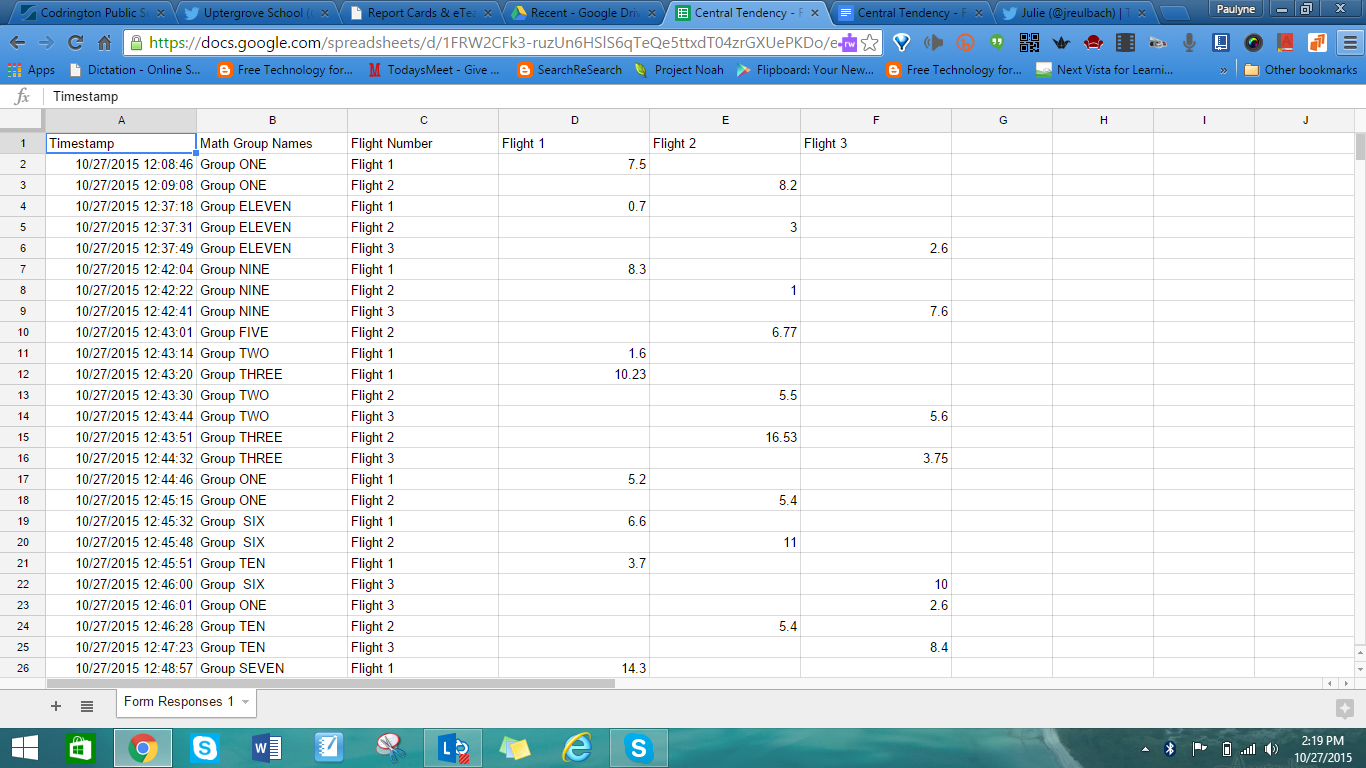
Day 35: Learning About Central Tendency - Just a short flight away…

I have had a number of opportunities to spend time with some amazing grade 7 & 8 students in Mr. Clark's class at Uptergrove PS.  Today, the students were engaged in a Math lesson where, through investigation, they were asked to demonstrate how to apply an appropriate measure of central tendency needed to compare sets of student-created data.  After some discussion/paired activities in the minds-on and action portions of the lesson, the question was posed:
How might you use central tendency in YOUR world?
The plan:
  1. make a paper airplane with a small group (2-3 in a group)
  2. we’ll go outside and fly our planes (3 flights each)
  3. measure the distance of the flights
  4. record our distances
  5. input our data into the google form!
  6. compare and analyze data
  7. determine the best measure of central tendency in analyzing the data, apply it and explain why


Of course the students rose to the challenge…


What was the result?  Highly engaged students who co-created relevant sets of data to be measured in a meaningful learning environment.  


So, why hands-on math learning?
*Learning through concrete representations is engaging.
*Students get the opportunity to move about and get physically involved in the math they are learning.
*Manipulating physical objects can work as tools to help conceptualize understanding.


What an exceptional afternoon in a terrific, intermediate class!!  Thank you, Mr. Clark for the opportunity to co-plan and co-teach!!


NOTE: **This paper airplane idea was found at ispeakmath.org by Julie Reulbach.
 

Thursday, 1 October 2015

Day 19: Coding and Holograms at Tosorontio


'Mr.Mac's' Grade 5/6 class was ready and raring to go this morning. I've never seen a more enthusiastic class first thing in the morning! Spheros and Ollies were awaiting some coding.
As a die hard Hour of Code class, they only needed a brief introduction to the 'Tickle' app and they were off. 
The Challenge: Code your robot to drive the taped line on the floor.
A variety of lines from a simple straight line (not so simple!) to squares, triangles and irregular polygons were pre taped to the classroom floor so that students had choice through parallel tasks. After successfully completing one line design, students were encouraged to tape their own design. 
The perseverance that they exhibited was note worthy, in that students did not just hop around from task to task when they were 'close enough', but stayed with a task and completed countless iterations to keep making it more and more precise. Amazing!!! The inherent problem solving and collaboration strategies involved in coding the bots to execute a specific task, was a joy to observe. Below, a group of girls debates angles and rotation direction, speed and time, in order to code the turn of a corner.
As Mr. MacAlpine and I were chatting about consolidation strategies, we self reflected on the task itself and discussed how even more powerful this activity could be if the students used the iPads (which they were using anyway) to take screen shots, videos and pictures all along the way to document their learning journey. They could then use an app like Adobe Voice to 'journal' about their task and post to a class or personal blog! I love the ideas that evolve out of self-reflective discussions amongst educators as to "how else could we do this?". Such powerful new learning almost always ensues! 

Deb Shackell came by to help our class code today and started brainstorming ideas on how to use Sphero in phys-Ed...Amazing & coming to a gym near you soon!
The next picture beautifully illustrates how learning never stops...EVERY student put up their hand when asked by Mr.Mac if they were going to ask for a Sphero for Christmas ;)
Next stop... grade 7/8!
Do holograms exist? Are they only "movie magic"? This class isn't quite sure, but they're willing to give it a try! Find the full slide deck for this activity @ bit.ly/STEAMholograms

First steps, create a net for a frustum with given dimensions for the trapezoid faces. (Thanks to Jay Speijer for teaching me that math lingo!) Tough! 

Mrs. Hodgin's class showed perseverance and learned that the sharing of good ideas is always better. Some people had a hard time with people 'stealing their ideas', but were soon turned around when I reminded them that, 'if your idea is good enough that someone else wants to use it...then that's a compliment. It means that they think it's awesome!'
It was also great to see the support of the school admin, as the VP and principal both came to share in the learning with us.

Next steps after lunch and recess... Turning the nets into acetate 3D figures...and making holograms!
Stay tuned!!!
After a whirlwind of trial and error we tested our devices to many ooo's and aaaahhh's. A dark space was required so we all piled into the boys changeroom and turned out the lights. Don't tell the principal ;)


3:20 came far too soon! We consolidated our learning and ended the day with more questions. Would other shapes work? Other sizes? Can we get it to stand up by itself? Is there something special about the video or can we make our own?
Needless to say, The kids are excited to try and make their own hologram videos using the 'explain everything' app tomorrow. Maybe we'll throw in some green screening or glow in the dark objects. I can't wait to see how they turn out!
Thank you to Tosorontio School today, who were all so welcoming in letting me come and play with them today!

Jamila Monahan